

- The banned list is short. Alcohol, pork, narcotics, weapons, fireworks, nutmeg, gambling gear, adult products and spy or eavesdropping devices can't enter at all.
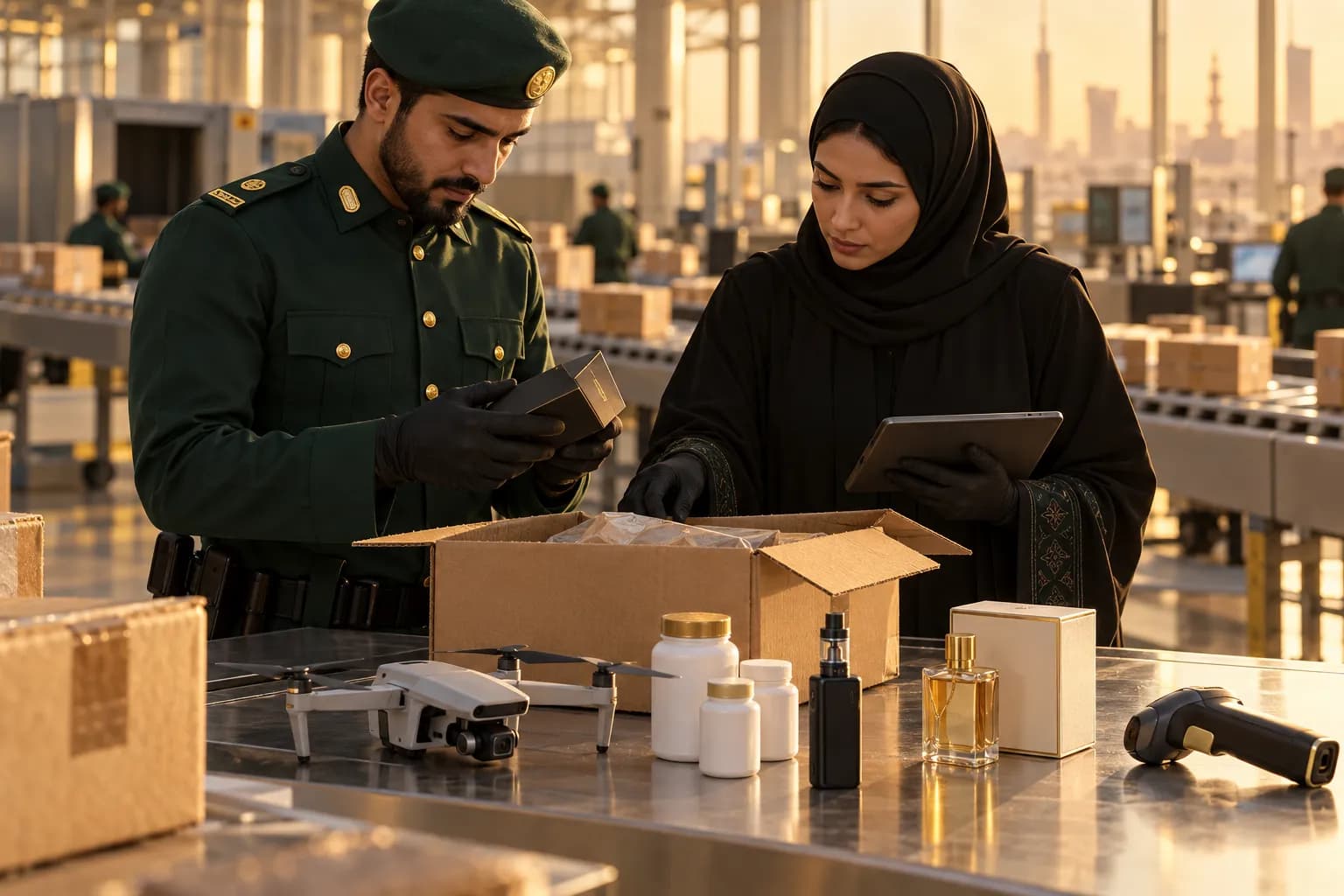
- Restricted goods are allowed with the right approval: SFDA for food, cosmetics, supplements and medical devices, CST for wireless kit, GACA for drones, SABER for regulated consumer products.
- Hidden ingredients cause many seizures. Gelatin, vanilla extract with alcohol and nutmeg are all on the wrong side of the line.
- E-cigarettes are legal in Saudi Arabia, but nicotine is capped at 20 mg/ml and only fruit and menthol flavours are allowed.
- Amazon and noon add their own rules on top: dangerous goods such as lithium batteries and perfume need extra handling or are excluded from some routes.
Good news first: almost everything that sells well online in Saudi Arabia can be imported.
Fashion, beauty, electronics, home goods, toys and sports gear all clear customs every day. The list of goods that are banned outright is short and predictable.
What trips sellers up is the middle ground. These are restricted goods that are perfectly legal but need an approval before they land, plus a few hidden ingredients and gadgets that customs treats as banned.
Here you'll find both lists, the agency behind each approval, the extra rules Amazon and noon add, and what to do if a shipment gets stopped.
What's the difference between prohibited and restricted goods?
Prohibited goods can't enter Saudi Arabia at all, whatever paperwork you have. Restricted goods can enter, but only with a permit, registration or certificate from the right government agency.
That difference decides what happens at the border:
- Prohibited. Customs confiscates the goods and can fine the importer. There's no fix.
- Restricted. Customs holds the goods until the approval is shown. Get it in time and they're released.
- Everything else. Normal clearance through FASAH, ZATCA's customs platform, with duty and 15% VAT.
ZATCA runs the border, but it rarely decides on restricted goods itself. Agencies such as the SFDA issue the approval, and ZATCA's restricted goods clearance service links that approval to your shipment.
For the duty side of clearance, see our guide to GCC customs duties.
Prohibited items: what you can't import into Saudi Arabia
ZATCA publishes the official list under a Ministry of Finance decision. Together with the long-standing bans on alcohol, pork and gambling, it covers these groups:
| Category | What's banned | Watch out for |
|---|---|---|
| Alcohol | All alcoholic drinks, and food made with alcohol | Vanilla extract, cooking wine, liqueur chocolates |
| Pork | Pork meat and derivatives | Gelatin capsules, gummies, lard, some brushes |
| Narcotics and drugs | Drugs of all kinds, intoxicants and unregistered pills | CBD and hemp products, poppy seeds in bulk |
| Medicines and sexual products | Pills, creams, herbs and sexual tonics not registered with the SFDA, abortion pills, sex toys | Herbal "male enhancement" supplements |
| Weapons | Weapons, ammunition, stun guns, tear gas | Replica guns, self-defence sprays |
| Fireworks | Fireworks of every type | Party poppers and sparklers |
| Surveillance gear | Hidden cameras in watches, pens or glasses, eavesdropping devices, speed radar detectors | Spy-cam chargers and smoke-detector cameras |
| Lasers | High-power lasers | Travellers may bring one red laser pen up to 5 mW |
| Plants and seeds | Nutmeg and nutmeg powder, kola nuts | Spice blends containing nutmeg |
| Tobacco types | Prohibited chewing tobacco and other smokeless tobacco | Shamma and similar products |
| Media and content | Immoral or pornographic material, uncleared publications, items offensive to Islam | Printed goods with religious text used as decoration |
| Money and gambling | Counterfeit currency, gambling machines and accessories | Casino chip sets, roulette wheels |
Customs brokers add commercial imports of used tyres and used clothing for resale to this list.
If your product sits in one of these rows, don't ship it. Find a version that fits, such as alcohol-free vanilla flavouring or halal beef gelatin.
Hidden traps: ingredients and gadgets that get stopped
Most seizures aren't drugs or weapons. They're everyday products with a banned ingredient or feature hidden inside.
Three traps catch the most sellers:
- Ingredients. Gelatin from pork in vitamins and sweets, alcohol in flavourings and perfume-style food sprays, nutmeg in spice mixes.
- Gadgets. Anything with a hidden camera or microphone, including "nanny cams" and recording pens. Radar detectors for cars are banned too.
- Claims. A supplement sold as a sexual or slimming aid gets treated as an unregistered medicine.
For example, a US vitamin brand ships gummies made with pork gelatin. The box says nothing about pork, but the ingredient list does, and customs reads it.
Restricted items: what needs an approval, and from whom?
Restricted goods are where most of the opportunity sits. Beauty, supplements, electronics and toys are some of Saudi Arabia's best-selling online categories, and all of them need approval.
Here's which agency approves what:
| Product type | Agency | What you need | Usually arranged by |
|---|---|---|---|
| Food, drinks, snacks | SFDA | Establishment and product registration in FIRS, health certificate, Halal certificate for animal ingredients | Saudi importer |
| Cosmetics and perfume | SFDA | Product notification in the GHAD system | Saudi importer or SFDA-licensed representative |
| Supplements and herbal products | SFDA | Registration, often classed as a health product | Saudi importer |
| Medical devices | SFDA | Medical Device Marketing Authorization (MDMA) in GHAD | Saudi Authorized Representative |
| Pet food | SFDA and MEWA | Import registration and veterinary checks | Saudi importer |
| Regulated consumer goods (electricals, toys, appliances) | SASO via SABER | Product Certificate (PCoC) per product, Shipment Certificate (SCoC) per shipment | Importer with a SABER account |
| Wireless and telecom devices | CST | Type approval for each radio model | Brand or Saudi importer |
| Drones | GACA (plus CST) | Drone registration and a customs clearance permit | Importer |
| Books and printed media | GAMR (media regulator) | Content clearance for each title | Saudi publisher or distributor |
| E-cigarettes and tobacco | SFDA and SASO | Product conformity and Arabic and English labelling | Licensed importer |
The common thread? A Saudi entity holds most of these approvals. That's usually your own company, a distributor or an importer of record service.
SABER for regulated consumer products
SABER is SASO's online platform for product conformity. Think of it as a passport for your product: you register each regulated item once, then get a shipment certificate before each consignment lands.
SABER charges SAR 500 for each Product Certificate (PCoC), which lasts a year. Each Shipment Certificate (SCoC) costs SAR 350 and is valid for 90 days.
Those fees exclude VAT. Lab and certification-body fees come on top.
The full process is in our SABER certificate guide for importers. Sourcing from China? Our SABER certification guide for Chinese suppliers covers the factory side.
SFDA for food, cosmetics and health products
The SFDA handles everything you eat, put on your skin or use for health. Cosmetics are notified in GHAD, which replaced the old eCosma system in 2023.
Food needs registration in FIRS before the first shipment, plus Arabic labelling and expiry dates. Our guide to SFDA rules for cosmetics, food and supplements walks through each system.
E-cigarettes, vapes and tobacco
Vapes are legal in Saudi Arabia. The SFDA's CEO said in January 2025 that there's no plan to ban traditional or electronic cigarettes.
The product rules are strict, though:
- Nicotine. E-liquids are capped at 20 mg/ml.
- Flavours. Only fruit, menthol or a mix of the two. Candy, dessert, coffee, cola and alcohol flavours are banned.
- Labels. Arabic and English, with health warnings and no promotional claims.
- Conformity. Devices follow SASO's technical regulation for electronic smoking devices, and e-liquids SFDA.FD 5005:2020.
Tobacco must come straight from the country of origin through approved ports. Raw tobacco and smokeless products such as shamma are banned, and tobacco pays 100% duty.
Marketplaces are stricter still. Amazon restricts tobacco and e-cigarettes for cross-border sellers, so plan to sell vapes through a licensed local importer.
Drones and wireless devices
Drones are allowed, with paperwork. Drones of 250 grams or more must be registered with GACA, the civil aviation authority, and GACA's portal issues the customs clearance permit.
Wireless kit needs type approval from CST, the Communications, Space and Technology Commission. That covers Bluetooth speakers, Wi-Fi routers, walkie-talkies, smart-home hubs and gaming headsets with radio links.
The approval is issued per model, usually to the brand or its Saudi importer, and certification consultants report it lasts about two years.
For example, a seller importing 200 camera drones needs GACA clearance, CST type approval for the radio and a SABER shipment certificate. Line all three up before the order leaves the factory.
Marketplace and courier restrictions
Customs is only the first filter. Amazon, noon and couriers have their own lists, and some legal products still can't use certain routes.
| Channel | Extra restrictions |
|---|---|
| Amazon.sa (cross-border from China) | Food, tobacco and e-cigarettes, and adult products restricted |
| Amazon SEND | Dangerous goods excluded |
| Amazon FBA | Dangerous goods charged extra storage fees and reviewed with a safety data sheet |
| noon Global Shipping | No items over 40 kg or longer than 120 cm, no KSA-restricted items |
| Express couriers and air freight | Lithium batteries and perfume need dangerous-goods handling |
Dangerous goods (DG) are products that can catch fire, leak or react in transit. Lithium batteries and alcohol-based perfume are the two most common in ecommerce.
They aren't banned. They just need the right packing, labels and a carrier that accepts them, which often means sea freight or a DG-approved air service.
Check category approvals on the marketplace before you buy stock. Gated categories such as beauty and health often ask for the same SFDA documents customs does.
What happens if customs seizes your shipment?
If a shipment is stopped, customs issues a seizure report and holds the goods. What comes next depends on which list the product is on.
- 1
Customs holds the goods
The shipment is stopped at the port or courier hub, and your broker or courier receives a notice through FASAH.
- 2
Find out why
Ask your broker for the exact reason: a missing permit, a banned ingredient, an undervalued invoice or a wrong HS code.
- 3
Restricted goods: present the approval
Upload the SFDA, CST, GACA or SABER approval within the deadline customs gives you, and the goods are released after normal duty and VAT.
- 4
If you can't get the approval
Ask your broker whether the goods can be re-exported at your cost. Otherwise they're destroyed, and storage fees keep running while you decide.
- 5
Prohibited goods: expect confiscation
Banned items are confiscated and destroyed, and the importer can be fined. Serious cases such as narcotics or weapons go to prosecution.
How big are the fines? Saudi law firms report fines of up to several times the value of the goods, doubled for repeat offences.
Undervaluing an invoice or splitting orders to dodge duty is treated as smuggling too. It can lead to fines, seizure and blocked accounts, so declare the real value every time.
Pre-shipment checklist by category
Run every new product through this list before you ship. It takes ten minutes and catches nearly every common hold.
Need a broker to check your HS codes? Compare customs brokers in Saudi Arabia or ask us for quotes below.
Notes for beauty and supplement brands
- Notify before you ship. Every cosmetic needs SFDA notification in GHAD. Supplements need registration and are often classed as health products.
- Check for hidden alcohol and pork. Gelatin capsules, collagen and some fragrances are the usual problems. Halal and alcohol-free claims also help sales.
- Perfume is dangerous goods. Alcohol-based fragrance needs DG handling for air freight, so plan sea freight for stock.
- Avoid medical claims. "Cures" or "treats" on the label can push a cream into the medicine category.
Notes for electronics sellers
- Radio means CST. Bluetooth, Wi-Fi and cellular features need type approval, alongside SABER.
- USB Type-C only. Phones, laptops, cameras, keyboards, mice and routers must now charge through USB Type-C, and SABER checks it.
- Batteries mean DG. Power banks and devices with lithium batteries need dangerous-goods packing and a willing carrier.
- Skip the grey zone. Hidden cameras, recording pens, radar detectors and high-power lasers are banned, even when they sell well elsewhere.
Most electrical products are SASO-regulated, so start with our SABER and SASO overview.
Notes for Chinese sellers
- Pick the route carefully. Amazon cross-border restricts food, tobacco and adult products, and Amazon SEND won't take dangerous goods.
- Use a Saudi importer. SFDA, SABER and CST approvals are held by a Saudi entity, so line up an importer of record before you ship.
- Match the paperwork. The model, HS code and factory on your SABER certificate must match the invoice exactly.
Notes for printed and branded goods
- Religious text. Don't use Quranic verses or religious symbols as decoration on products, packaging or footwear.
- The Saudi flag. It carries the Shahada, so it must never appear on disposable items or clothing worn below the waist.
- Maps. Check that maps on products show borders the way Saudi Arabia recognises them.
- Publications. Books and magazines for sale need GAMR content clearance, applied for by a Saudi publisher or distributor.
Back to the full logistics guides for shipping, fulfilment and customs.
Frequently asked questions
Yes, if they're registered with the SFDA and free of banned ingredients such as gelatin from pork. Small personal orders sometimes get through, but commercial stock needs a Saudi importer who registers the products first. Check every capsule shell and flavouring before you send anything.
Sources & further reading
- Restricted or Prohibited Goods — Zakat, Tax and Customs Authority (ZATCA)
- Restricted Goods Clearance (e-service) — Zakat, Tax and Customs Authority (ZATCA)
- E-Store Customers (customs rules for online purchases) — Zakat, Tax and Customs Authority (ZATCA)
- Technical Regulation SFDA.FD 5005:2020, Electronic Nicotine Delivery Systems — Saudi Food and Drug Authority (SFDA)
- Saudi Arabia e-cigarette main policies — Campaign for Tobacco-Free Kids
- Unmanned Aircraft Registration portal — General Authority of Civil Aviation (GACA)
- SABER platform — Saudi Standards, Metrology and Quality Organization (SASO)
- Clearance of foreign books and publications — General Authority for Media Regulation (GAMR)
- Food Clearance Conditions and Requirements — Saudi Food and Drug Authority (SFDA)
This guide is for general information only and is not legal, tax or financial advice. Rules and fees change — always confirm with the official source or a licensed advisor.

Maya is MiddleEastEcom's lead guide and editor. She researches GCC marketplaces, payments and regulations and turns them into practical playbooks for sellers.
Meet Maya