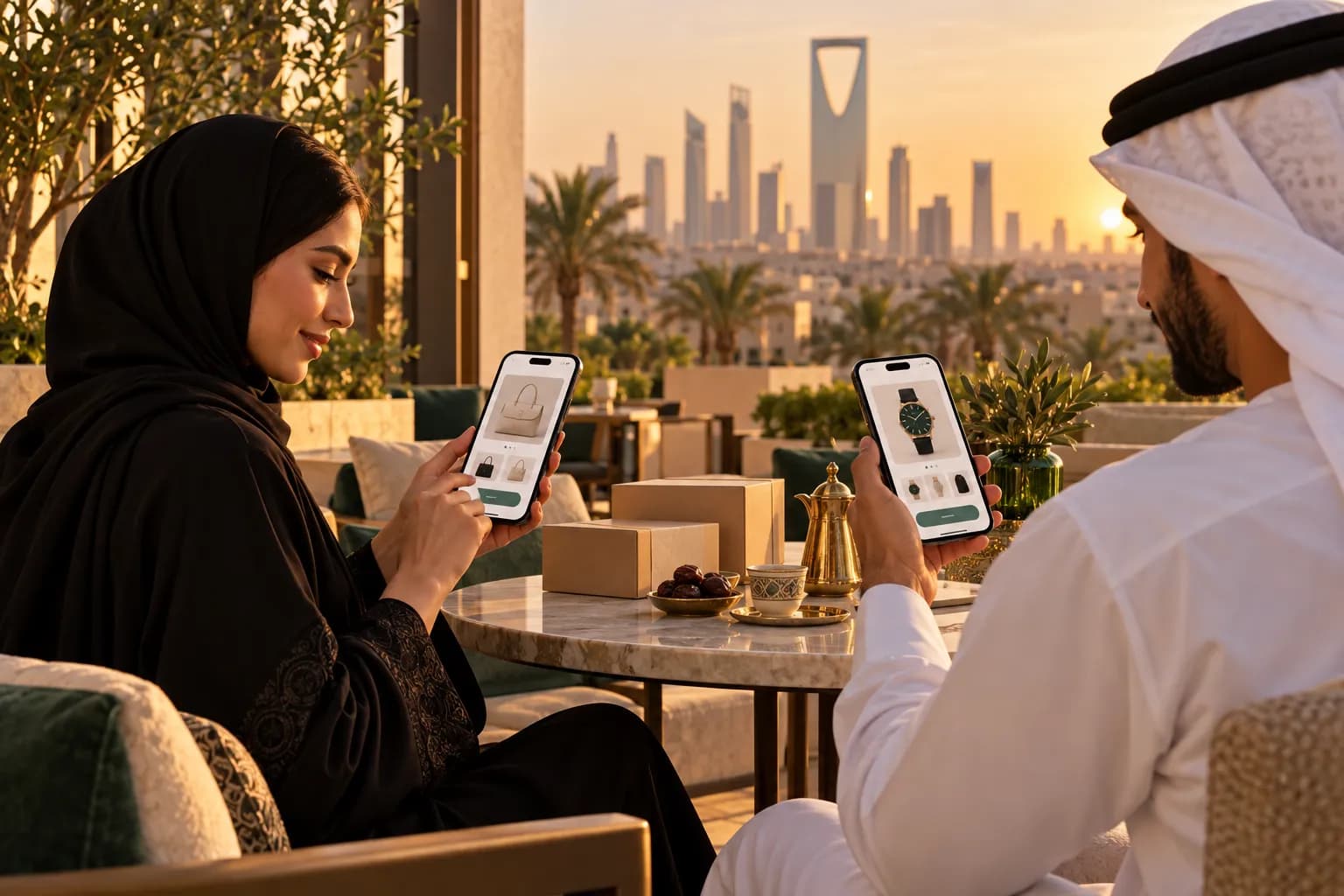

- Phones carry about 79% of Saudi B2C ecommerce value. Design every page for a phone first and treat desktop as the adaptation.
- Start with a fast mobile website, not an app. Add an app once repeat customers drive a large share of revenue.
- Make checkout phone-first: phone number plus OTP as the login, guest checkout, the National Address and Apple Pay at the top.
- Gulf networks are among the fastest in the world. If your store feels slow, heavy apps, scripts and fonts are the cause.
- Send shoppers from Snapchat, TikTok and Instagram to short, video-led pages, and keep a WhatsApp button one tap away.
Gulf shoppers buy on their phones. In Saudi Arabia, smartphones carry about four in five riyals spent online.
That's good news for you. A small brand with a fast, well-built mobile store can look as polished as noon or Amazon on a 6-inch screen.
The bar is high, though. Saudi and Emirati shoppers tap Apple Pay at cafés every day, so they expect checkout to feel just as quick.
Here's how to design for that shopper: what to build, how fast it must be, how to set up checkout and how to test it before launch. It's part of our localization guides for Gulf stores.
How mobile is Gulf online shopping?
Very. Almost every Saudi adult goes online through a phone, and most online sales happen there too.
Web traffic tells only part of the story. On top of mobile browsing, shoppers spend hours in the noon, Amazon, Shein and Namshi apps. So the real mobile share of orders is higher than any traffic chart shows.
Source: StatCounter, September 2026. App sessions are not included.
The UAE leans a little more on desktop. Office browsing and a large expat workforce push its desktop share to about 39%. Even there, smartphone orders grew by a fifth in the first half of 2026.
Mobile does have one weak spot: conversion. Gulf agencies see desktop visits convert at up to twice the phone rate. Most of that gap is friction you can fix.
For example, take a Saudi store with 20,000 visits a month and an average order of SAR 250. Phones bring 68% of those visits:
| Phone | Desktop and tablet | |
|---|---|---|
| Visits a month | 13,600 | 6,400 |
| Conversion rate | 1.0% | 2.0% |
| Orders a month | 136 | 128 |
| Revenue a month | SAR 34,000 | SAR 32,000 |
Phones bring two-thirds of the visits but only about half the orders.
Now lift phone conversion to 1.5%. That gives you 204 phone orders instead of 136.
That's 68 extra orders, or SAR 17,000 more revenue a month from the same traffic. For benchmarks by channel and category, see Saudi ecommerce conversion rates.
Should you build an app or a mobile website?
Start with a mobile website. For a new brand, an app adds cost and an install step without adding customers.
Marketplaces push apps because they already have millions of repeat buyers. You're still finding your first thousand. Most of them will arrive from a Snapchat, TikTok or Instagram ad, and an ad opens a web page, not an app.
| Mobile website | PWA | Native app | |
|---|---|---|---|
| Opens straight from ads and WhatsApp links | |||
| Found in Google search | |||
| Push notifications | Partly | ||
| Saved to the home screen | |||
| Build cost | Included in Shopify, Salla or Zid | Low | High: iOS and Android |
| Best for | Launch and paid social | Growing repeat base | Loyal, frequent buyers |
So when does an app make sense? When returning customers bring in a large share of revenue and buy often. Grocery, beauty refills and fashion brands with weekly drops get there first.
Until then, put the money into speed, checkout and WhatsApp. Salla and Zid both sell branded store apps as an add-on, so the upgrade path is easy when you're ready.
Make it fast on mobile networks
Gulf mobile networks are among the fastest in the world. Saudi 5G runs at a median of about 320 Mbps.
That changes where your speed problem lives. It's almost never the network. It's the store itself:
- App stacks. Every review widget, upsell pop-up and chat bubble adds scripts. Remove any app you can't tie to sales.
- Arabic fonts. Load one Arabic font family with 2–3 weights, hosted on your own store. Heavy font files are a common cause of slow Arabic pages.
- Images. Compress product photos and size them for the screen. A 4,000-pixel hero image on a phone is wasted data.
- Video. Use short, compressed clips that start muted, and never block the page while they load.
Measure with Google's Core Web Vitals, the speed scores in Search Console and PageSpeed Insights. Aim for these targets on mobile:
| Metric | What it measures | Target |
|---|---|---|
| LCP (Largest Contentful Paint) | How fast the main image or headline appears | 2.5 seconds or less |
| INP (Interaction to Next Paint) | How fast the page responds to a tap | 200 ms or less |
| CLS (Cumulative Layout Shift) | How much the page jumps while loading | 0.1 or less |
Test the Arabic version separately. It often loads extra fonts and translation scripts, so it can fail where the English version passes.
RTL on small screens
Arabic stores read from right to left (RTL). On a phone, small mirroring mistakes become big usability problems.
Focus on what a thumb touches:
- Sticky buy bar. Keep "add to cart" in a fixed bar at the bottom, full width, so it works for either hand.
- Floating buttons. Put the WhatsApp bubble where it won't cover the buy bar or the cookie banner in Arabic.
- Swipe galleries. In RTL, the next product image should arrive from the left. Check that your slider is set up for it.
- Label length. Arabic labels can wrap to two lines. Test menus and buttons on a narrow 375px screen.
- Number fields. Keep phone, card and OTP fields left to right, and accept Arabic-Indic digits typed by the keyboard.
For the full mirror and don't-mirror rules, see our Arabic RTL design guide.
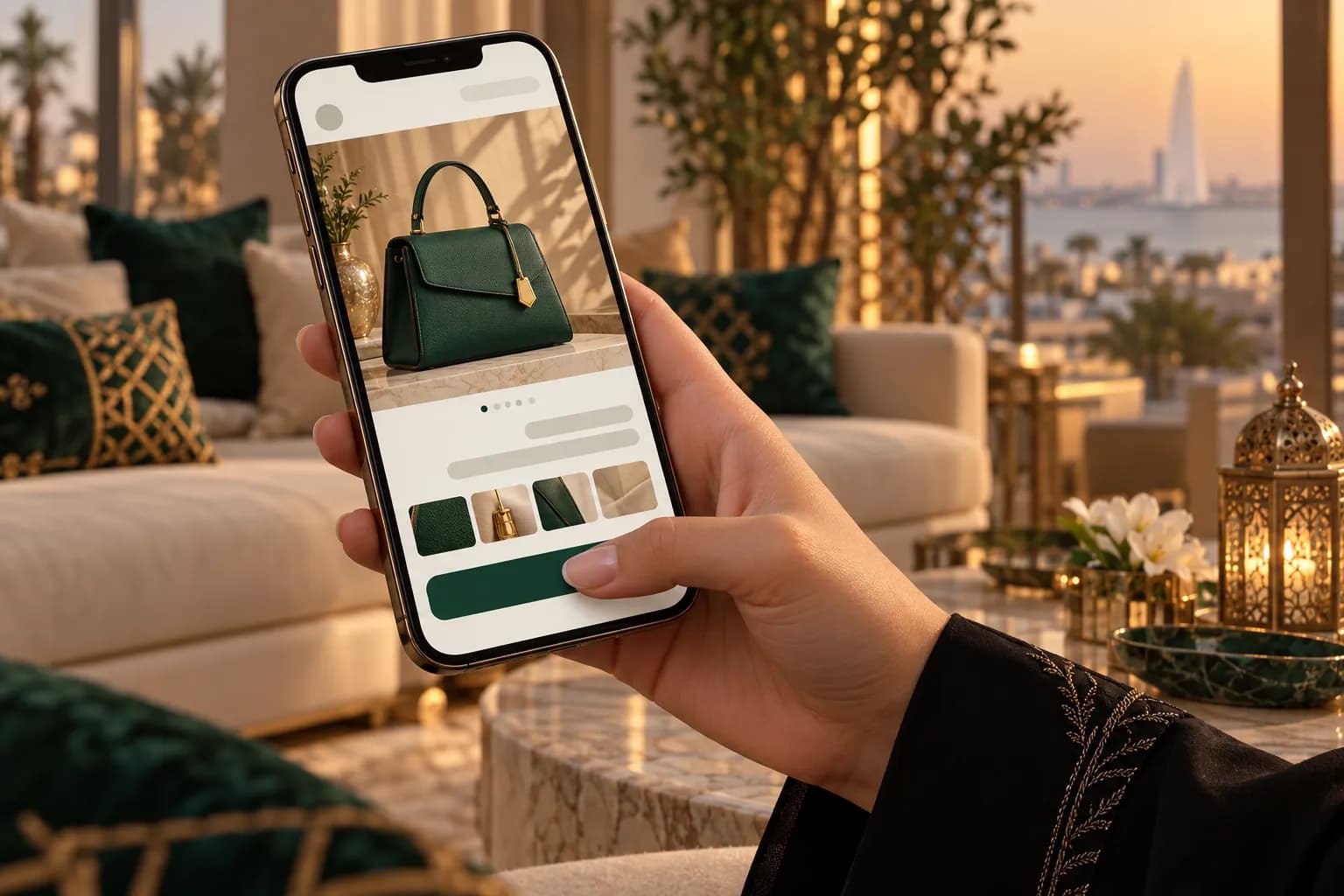
Design a thumb-friendly checkout
A Gulf mobile checkout should take under a minute. Every field you remove makes that easier.
Here's the shape that works:
- Phone number first. Use the +966 or +971 number as the login, confirmed with a one-time code by SMS or WhatsApp. Make email optional.
- Guest checkout. Let shoppers buy without creating an account. Offer to save their details after the order.
- Code autofill. Mark the code field as a one-time code, so iPhone and Android fill it straight from the SMS.
- Short address. In Saudi Arabia, accept the National Address short code with a map pin. In the UAE, ask for building and a landmark.
- One column, big buttons. Keep every field full width and use the right keyboard: number pad for phone, email keyboard for email.
- Wallets on top. Show Apple Pay and mada first, so most shoppers never see a card form.
Want to see where your checkout leaks today? Our guide to why Gulf shoppers abandon checkout walks through each cause and fix.
Apple Pay: the one-tap checkout
Apple Pay is the fastest checkout a Gulf phone shopper can get. It's live in all six GCC countries.
It solves two mobile problems at once. Shoppers don't type a card number on a small screen. And they don't wait for the bank's SMS code, because Face ID confirms the payment instead.
Put an express Apple Pay button on the product page and in the cart, not only at the final step. Most Saudi shoppers keep a mada card in their wallet, so ask your gateway to price those payments at the mada rate.
For gateway setup and costs, see Apple Pay for Saudi stores.
WhatsApp and Snapchat deep links
Most of your mobile traffic will start inside another app. Your links need to work there.
A deep link is a link that opens a specific place: a product, a cart or a WhatsApp chat. Set them up like this:
- Snapchat and TikTok ads. Link to a short, video-led product page, not your home page. Add UTM tags, because these apps' in-app browsers hide much of the traffic in Google Analytics.
- In-app browsers. Test checkout inside Snapchat, TikTok and Instagram. Shoppers aren't logged in there, so your phone-number login has to work smoothly.
- WhatsApp chat links. A wa.me link with a pre-filled Arabic message ("I'd like to ask about this product") opens a chat in one tap. Add the product name to the message so your team knows the context.
- Cart links. When a chat ends in a sale, send a link that opens the cart with the item already in it.
- Click-to-WhatsApp ads. Meta opens a free messaging window of up to 7 days after a shopper taps one. That makes ad-to-chat-to-checkout cheap to run.
Snapchat ads reach about 73% of Saudi Arabia's population, so this channel alone can be your biggest source of mobile traffic.
Bring phone shoppers back: push, SMS and WhatsApp
Email works for UAE expats and higher-value buyers. Most Saudi shoppers respond faster on WhatsApp and SMS.
Each channel has its own job:
| Channel | Best for | Rules and costs (2026) |
|---|---|---|
| Abandoned carts, COD confirmation, delivery updates, offers | Saudi and UAE marketing message: $0.0576. Saudi utility message: $0.0107. Opt-in required | |
| SMS | OTP codes, short promos to shoppers not on WhatsApp | Saudi promo sender ID must end "-AD", sent 09:00–20:00. UAE sender ID starts "AD-", no promos 21:00–07:00, UAE-registered senders only |
| App or web push | Back-in-stock, price drops, flash sales for repeat buyers | Needs an app or a PWA with permission |
| Receipts, newsletters, UAE and B2B customers | Bilingual templates with RTL layout for Arabic |
The WhatsApp price gap is worth knowing. Marketing messages cost about five times as much as order updates in Saudi Arabia.
For example, an offer sent to 20,000 opted-in Saudi numbers costs about $1,152 in Meta fees. Sending 20,000 shipping updates costs about $214. Your provider's fee comes on top of both. Plan your mix with our WhatsApp cost calculator.
Always collect opt-in at checkout, with the consent text in Arabic. It keeps you within Saudi and UAE data rules and keeps your number from being blocked.
Test your mobile store before launch
Test on real phones, in both languages, on mobile data. Office Wi-Fi and a desktop browser hide most problems.
Repeat the test after every new app, theme update or campaign landing page. Most mobile breakages arrive with a small change nobody tested.
Notes for Shopify stores
- Pick a lightweight theme with a built-in sticky add-to-cart bar instead of adding an app for it.
- Shopify Payments works for UAE companies and includes Apple Pay. Saudi stores need a local gateway that supports mada and Apple Pay.
- Audit your apps every quarter. Each one usually adds scripts to every page, including the Arabic version.
Notes for Salla and Zid stores
- Both platforms are built in Saudi Arabia, so phone login, mada and Apple Pay come ready to switch on.
- On Salla, Apple Pay turns on automatically once mada and Visa are active. Online card payments need the Plus plan or above.
- Both sell branded store apps as add-ons. Salla's Pro plan includes one, which makes it the simplest path to push notifications.
Notes for UAE-focused sellers
- Expect more desktop traffic than in Saudi Arabia, so check your desktop checkout too.
- English matters more for the expat majority. Run both language versions through the full mobile test.
- Apple Pay and cards lead UAE mobile checkout. Put Tabby next to them for higher-value baskets.
Frequently asked questions
Not at launch. Noon, Amazon and Shein push their apps because they have millions of repeat buyers. A new brand gets more from a fast mobile site that loads straight from a Snapchat or Instagram ad with no install step. Revisit the app question once returning customers bring in a big share of your sales.
Sources & further reading
- Desktop vs mobile vs tablet market share, Saudi Arabia and UAE (Sep 2026) — StatCounter
- Saudi Arabia E-commerce Market (2026) — Mordor Intelligence
- Saudi Internet Report 2025 — Communications, Space and Technology Commission (CST)
- UAE e-commerce defies regional slowdown (Admitad and Udora, H1 2026) — Khaleej Times
- Average ecommerce conversion rate: UAE benchmarks 2026 — RATH Infotech
- WhatsApp Business Platform pricing — Meta for Developers
- The bustling Ramadan night-time economy — Visa
This guide is for general information only and is not legal, tax or financial advice. Rules and fees change — always confirm with the official source or a licensed advisor.

Maya is MiddleEastEcom's lead guide and editor. She researches GCC marketplaces, payments and regulations and turns them into practical playbooks for sellers.
Meet Maya