
- Noon ranks listings that match the search, convert well and are in stock. Titles, attributes, Arabic content, price and FBN all feed that.
- Write an Arabic title for every product. Noon doesn't translate, and English-only listings may not show on the Arabic site.
- Research Arabic keywords from scratch. Saudis type جوال, not موبايل, and often write English words in Arabic script, like لابتوب.
- Titles run 20–160 characters with no brand name, plus up to five bullets and at least three white-background JPEG images.
- Several sellers share one product page, so price, stock and FBN decide who wins the Buy Box.
A great product with a weak listing sits on page five. On noon, the fix is usually simple: better words, better pictures and a sharper offer.
Here's the good news. Noon is far less crowded than Amazon, and sellers report that a well-built listing can reach page one within weeks.
Noon also hides sales counts and doesn't hold new listings back for lack of reviews. So a newcomer with great content can compete with sellers who've been there for years.
Below, you'll learn to write titles in English and Arabic, pick the words Gulf shoppers really type, and win the Buy Box. There's a full before-and-after makeover near the end.
How does noon decide which products rank?
Noon doesn't publish its ranking formula. But sellers and agencies agree on what moves a listing up, and it comes down to three questions:
- Is it relevant? Noon matches the shopper's words against your title, attributes, bullets and description. If a word isn't in your content, you won't show for it.
- Does it sell? Listings that get clicked and bought climb. Images, price, ratings and the noon Express badge drive that.
- Can noon deliver it? Out-of-stock offers drop out. FBN (Fulfilled by noon) stock gets the Express badge and fast delivery, which noon favours.
Relevance gets you into the results. Conversion keeps you near the top. So start with the words.
Step 1: Find the words shoppers actually type
Keyword research on noon starts in the noon app, not in a translation tool. Type your product into the search bar in English, then switch the app to Arabic and do it again.
Write down every autocomplete suggestion. Then open the top five listings in each language and note the nouns in their titles.
These sources give you the real vocabulary:
- Noon autocomplete in both languages, on the Saudi and UAE stores.
- Top-selling listings' titles in your category.
- Google Trends, set to Saudi Arabia or the UAE, to pick between Arabic variants.
- Your own ads reports, once you're running ads. They show the exact search terms that led to sales.
Arabic synonyms and Gulf dialect
Arabic has a formal written form (MSA) and many spoken dialects. Gulf shoppers often search with everyday words, not textbook ones.
For example, a year of Google Trends data shows how much the word choice matters:
| Product | Words people search | Saudi Arabia | UAE | Use in your title |
|---|---|---|---|---|
| Mobile phone | جوال / موبايل / هاتف | 82 / 16 / 25 | 14 / 30 / 61 | جوال for Saudi, هاتف for the UAE |
| Bag | شنطة / حقيبة / شنط | 54 / 12 / 46 | 46 / 11 / 46 | شنطة in the title, حقيبة in the description |
| Shoes | جزمة / حذاء / جوتي | 31 / 58 / 4 | 0 / 57 / 50 | حذاء leads, جزمة a strong second; add جوتي for the UAE |
| Slippers | نعال / شبشب | 39 / 42 | 33 / 2 | Near tie in Saudi, so cover both; نعال for the UAE |
| Air conditioner | مكيف / تكييف | 52 / 4 | 48 / 10 | مكيف |
| iPhone | ايفون / آيفون / iphone | 37 / 2 / 38 | 3 / 0 / 42 | Both scripts for Saudi, Latin for the UAE |
| Discount code | كود خصم / كوبون / رمز خصم | 71 / 17 / 1 | 69 / 18 / 0 | كود خصم, never رمز خصم |
Scores show relative interest within one country, where 100 is the most-searched term.
The Saudi word جوال wins easily in Saudi Arabia. In Egypt, the colloquial موبايل wins instead, so a listing translated by an Egyptian writer can miss most Saudi searches.
Transliteration and spelling variants
Gulf shoppers also type English words in Arabic letters. These are often the biggest search terms, not the "pure" Arabic word:
- English in Arabic script: لابتوب (laptop), سيروم (serum), بلوتوث (Bluetooth), ايفون (iPhone).
- Hamza: shoppers often skip it, so check اسعار vs أسعار.
- Taa marbuta: عباية vs عبايه.
- Singular and plural: عطر رجالي vs عطور رجالية.
Arabizi, Arabic in Latin letters with numbers (like "3atr" for عطر), is common in chat but rare in search, so skip it.
Pick the most-searched form for the title. Use the others naturally in bullets and the description. Our Saudi Arabia SEO guide explains the full research method.
Step 2: Write titles in English and Arabic
The title is your strongest ranking signal and the first thing shoppers read. Noon wants it between 20 and 160 characters.
Follow noon's pattern: key feature + product type + model + colour. Noon's own example is "Handheld Portable Garment Steamer 1500 W HST1500 Black".
Noon rejects titles that break its rules. Leave out:
- The brand name. It has its own field and shows above the title.
- Promotional text, like "best", "hot deal" or "free gift".
- Special characters, such as @ ^ * # &.
- ALL CAPS and repeated words.
- The colour, if noon already adds it from the colour attribute.
Use title case in English, except for small words like "and" or "with".
Your Arabic title
English content is mandatory to go live in Saudi Arabia and the UAE. Arabic is optional on paper, but noon doesn't translate your content. English-only listings may not show on the Arabic site at all.
So write an Arabic title for every product, and start it with the noun shoppers search. "كوب حافظ للحرارة" beats a clever product name nobody types.
Write it in clear, simple MSA with the Gulf words from your research. Use Western digits (1.2 لتر, not ١٫٢ لتر) and keep model numbers in Latin letters.
Step 3: Fill every attribute
Attributes are the structured fields in Seller Lab: size, material, capacity, colour, compatibility and so on. They power noon's filters, and shoppers use filters a lot.
Here's why they matter:
- Filters. If a shopper filters by "1–1.5 L" and your capacity field is empty, you vanish from that view.
- Quality check. Mandatory attributes must be 100% complete, or the listing won't pass.
- Content score. Optional attributes raise your content-quality score. Fill as many as you truthfully can.
- Variants. Group sizes and colours under one parent, so ratings and sales build on one page.
Pick the most specific category too. A tumbler filed under "kitchen, other" competes badly with one in "drinkware".
Step 4: Write bullets and a description that sell
Bullets are what shoppers scan before they decide. Noon allows up to five, each 250 characters or fewer.
Lead each bullet with the benefit, then the proof. "Keeps drinks cold for 24 hours; double-wall vacuum steel" works better than "Made of steel".
Noon's format rules are strict:
- Separate bullets with semicolons and skip the closing full stop.
- Description: 250–4,000 characters. Use it for use cases, care, sizing and what's in the box.
- Never include links, emojis, prices, warranty claims or other marketplaces' names.
Write for the Gulf buyer, not from the English sentence. "Perfect for summer" means something different at 45°C; say it keeps water cold in the car.
For Arabic bullets, watch the gender. Use feminine verbs for women's products (اختاري) and neutral wording for unisex ones. Mixed-up gender is the clearest sign of a machine translation.
Step 5: Images, video and A+ content
Images sell the click and the purchase. Noon's minimum rules are easy to meet:
- Format: JPEG, at least 660 px wide, 72 PPI or more, under 10 MB, sRGB colour.
- Main image: pure white background (light grey for fashion), front view, with the product filling 70–80% of the frame. No packaging or tags.
- How many: at least three, in this order: front, back, side, other angles, details, then in use.
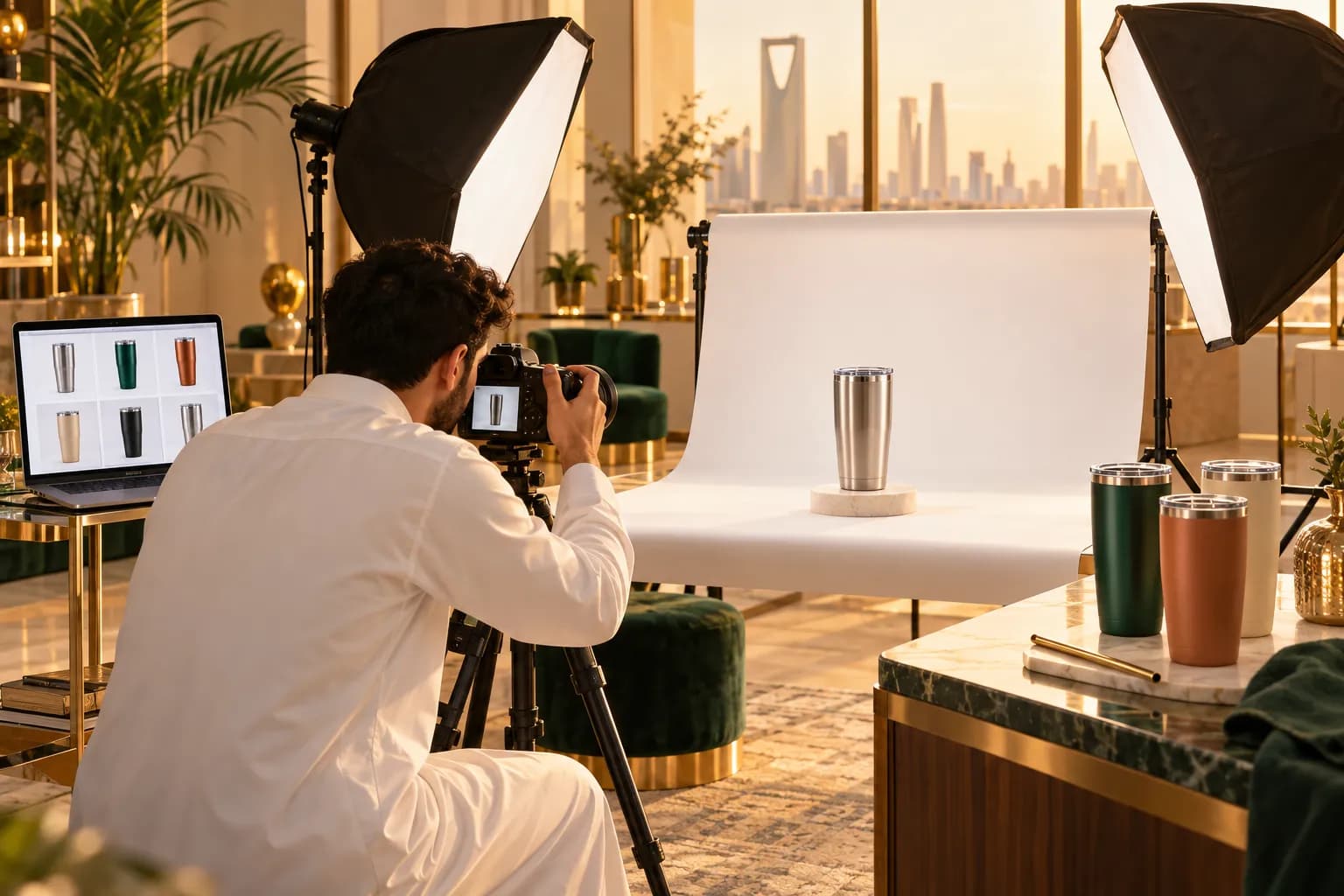
Minimum is not the goal. The listings that win add lifestyle shots in a Gulf setting and infographics with short Arabic labels: capacity, size in cm, what's in the box.
Video and A+ content
You can add a product video as an MP4 under two minutes and 8 MB. A 20–30 second clip of the product in use is plenty.
A+ content, which noon calls rich content, adds banner images below the listing. Each banner is 2000×1000 px. A full set runs 6–13 slices.
Use A+ to tell the brand story, compare your models side by side and answer the questions that cause returns. Put the Arabic version on the Arabic listing, not English banners on both. A product photography studio can shoot the main images and A+ set in one session.
Step 6: Price and stock to win the Buy Box
Noon shares catalogue pages, like Amazon. If several sellers offer the same product, only one gets the main "Add to cart" button, called the Buy Box. The rest sit under "other sellers", where few shoppers look.
Here's what wins it:
- Price. The lowest landed price usually wins, so watch competitors weekly.
- FBN stock. FBN offers carry the noon Express badge and get a Buy Box advantage.
- Supermall. Stock picked for noon's 45–90 minute delivery gets an extra Buy Box boost.
- Stock depth. An offer that keeps running out loses its spot.
Don't win the Buy Box at a loss, though. Run your numbers first: commission, FBN fee, VAT and ads all come off the shelf price.
Marketplace fee calculator
Amazon.sa, Amazon.ae and noon: see what you keep from every sale
Minimum referral fee: SAR 1.00 per item.
The price the shopper pays.
Landed cost: product, freight, duty.
Your numbers
Payout per unit
SAR 89.18What the marketplace transfers to you
Profit per unit
SAR 37.55Margin: 36.0% of price excl. VAT
- Referral fee(14.0% of price)
- SAR 16.80
- FBN outbound fee
- SAR 10.00
- VAT on fees (15.0%)(reclaimable)
- SAR 4.02
- Total marketplace fees
- SAR 30.82
- Net VAT you remit
- SAR 11.63
- Product cost
- SAR 40.00
Where the price goes
- Referral14.0%
- Fulfillment8.3%
- VAT on fees3.3%
- Net VAT9.7%
- Product cost33.3%
- Profit31.3%
Excludes storage, ads, returns and promotions. Estimates based on published Amazon (Aug 2025) and noon (Sep 2026) rate cards, as of 26 October 2026. Confirm with the marketplace before pricing.
If your price leaves no margin, compete on a bundle or your own brand listing instead. Every category rate is in our guide to noon seller fees.
Step 7: Earn reviews and keep your rating high
Ratings don't gate new listings on noon, so you can sell before you have any. But they matter as you grow, in three ways:
- Conversion. A 4.5-star listing simply converts better than a 3-star one next to it.
- Supermall. Noon picks products for fast delivery partly on SKU rating, seller rating and return rate.
- Ranking. Better conversion feeds better organic rank.
Reviews follow sales and happy customers. The listings with the best ratings do the boring things well:
- Show the product honestly. Real colours, real sizes, real in-box contents.
- Add a size or compatibility guide. Most bad reviews start with "not what I expected".
- Ship through FBN. Fast, tracked delivery heads off delivery complaints.
- Pack properly. Gulf heat and long routes are hard on fragile items.
- Read every low review. Fix the listing or the product, so the next buyer doesn't hit the same problem.
Never pay for reviews or offer gifts for five stars. It breaks marketplace rules and puts your account at risk.
Before and after: a noon listing makeover
Take an insulated steel tumbler, one of noon's fastest-moving summer niches. The "before" is the kind of listing sellers often upload on day one.
| Before | After | |
|---|---|---|
| English title | BEST 40oz Tumbler!!! Steel Cup *HOT DEAL* Brand X | Insulated Stainless Steel Tumbler 1.2 L with Handle and Straw, Leak-Proof Lid |
| Arabic title | كوب حافظ للحرارة ستانلس ستيل 1.2 لتر مع مقبض وشفاط وغطاء مانع للتسرب | |
| Arabic keywords covered | كوب حراري، مق، ترمس، تمبلر، كوب قهوة للسيارة | |
| Units | 40 oz | 1.2 L, cm sizes, fits car cup holders |
| Attributes | Mandatory only | Every field, incl. capacity, material, lid type |
| Images | 2 photos, grey background | 7: white main, angles, in a car, ice test, Arabic infographic |
| A+ content | 6 Arabic slices: cold-hours test, sizes, care | |
| Fulfilment | FBP | FBN, with the noon Express badge |
Each change fixes a specific problem:
- The title follows noon's pattern. Feature, type, capacity and key extras, with no brand, caps or promo words. It would no longer bounce at quality check.
- The Arabic title leads with the searched noun. كوب حافظ للحرارة is what Saudi shoppers type, and the description covers the variants: مق, ترمس and the transliterated تمبلر.
- Metric units. Gulf shoppers think in litres and centimetres, not ounces.
- Images answer questions. Does it fit a car cup holder? Is the ice still there after a day? Each shot removes a reason to hesitate.
- FBN adds the Express badge, which noon says lifts conversion by about 60%.
Pair the new listing with a small ads campaign on long-tail Arabic terms. Sellers report clicks at SAR 0.3–0.5 on terms like these, and our noon ads guide shows how to set it up.
Your noon listing checklist
Run every new product through this list before you submit it:
Notes for Saudi and UAE listings
The two stores share Seller Lab, but shoppers search differently:
- Saudi Arabia is Arabic-first. Put your best effort into the Arabic title and bullets, and use Saudi words like جوال.
- The UAE is more bilingual. English carries more searches, but Emiratis and Arab expats still search in Arabic, so keep both.
- Prices differ. Show SAR with 15% VAT included in Saudi Arabia, and AED with 5% VAT in the UAE.
Notes for Chinese sellers
Sellers on noon Global Shipping still write their own content. Noon doesn't translate it, so plan for Arabic from day one:
- Hire a Gulf Arabic writer for titles and bullets, and give them your keyword list.
- Swap ounces and inches for litres and centimetres in every field.
- Shoot lifestyle images with Gulf settings and modest styling, not ones made for Western markets.
The rest of the setup is in our noon Global Shipping guide.
Notes for fashion brands
Fashion is noon's most crowded category, so listings must work harder:
- Main images can use a light grey background instead of white.
- Size guides are essential. Add UK/EU sizes and, for abayas, lengths in inches as Gulf shoppers expect.
- Modest styling in model shots matters, especially in Saudi Arabia.
- Use dialect nouns like شنطة and نعال in titles, where the data backs them.
Get help with your noon listings
Writing great bilingual listings takes time, and many brands hand it to specialists for their first catalogue. Compare Arabic translation agencies for copywriting, or find full-service noon and Amazon marketplace agencies that handle listings, ads and stock. Every other noon guide is on the noon seller hub.
Frequently asked questions
Check the basics in order. Is the offer live and in stock in that country? Did it pass the quality check? Does it have an Arabic title, if you're searching in Arabic? Then check the category and attributes, because a product filed in the wrong category rarely shows for the right search.
Sources & further reading
- Title requirements and rejection reasons for the seller SKU — noon Seller Help Center
- Image requirements and rejection reasons for the seller SKU — noon Seller Help Center
- Feature bullets, product highlights and description for the seller SKU — noon Seller Help Center
- Seller SKU content language requirements — noon Seller Help Center
- Supermall FAQs — noon Seller Help Center
- What is FBN or noon Express? — noon Seller Help Center
- Google Trends, 12-month comparisons for Arabic product terms (pulled 26 Oct 2026) — Google
- Amazon UAE vs Noon UAE: a seller's comparison — fbacalculatoruae.com
This guide is for general information only and is not legal, tax or financial advice. Rules and fees change — always confirm with the official source or a licensed advisor.

Maya is MiddleEastEcom's lead guide and editor. She researches GCC marketplaces, payments and regulations and turns them into practical playbooks for sellers.
Meet Maya